Showing posts with label Mitochondria. Show all posts

Friday, August 17, 2012

Ketone and Fat "Burning" are Not the Same Thing to Your Mitochondria

This notion of being a "sugar burner" vs. a "fat burner" -- with the latter being touted as preferable based on nothing I've seen in the scientific literature -- is getting really out of hand.  This is not a new idea, but it certainly seems to be being pushed more lately, particularly in the area of athletic performance.  There were a smattering of posts about the diets of Olympians about the net and I just have to shake my head at the one that goes something like "just imagine how much better fill in the blank would do if (s)he didn't eat grains" or "ate LCHF" or "went paleo".  C'mon already ... Michael Phelps is a prime offender of all laws and gods nutritional, but will someone please remind me how many medals he's earned and records he's held/broken in his career?  Gawd forbid any of these elite athletes set a bad example by having their face put on a box of Wheaties!  I dunno ... it all seems so silly when Phelps sports one of the leanest torsos on the planet burning sugar.  But I digress ...

But with ketomania in full-blown fad form, there's a new twist on the fat burning meme which is to confuse fat burning with ketone burning.  It is not.  Yes, ketones are produced mostly from the breakdown of fatty acids (they are also produced from some amino acids), so you "burn fat" in your liver to produce them.  If you are in caloric deficit, the source of the fatty acids will be body fat.  However, if you're fueling the other cells of your body with ketones, this is not the same as the mitochondria in those cells "burning fat".  

Below is a schematic of a brain cell mitochondria and the metabolic pathways showing where ketones feed into Krebs (aka the TCA), from:  D-β-Hydroxybutyrate protects neurons in models of Alzheimer's and Parkinson's disease (thus it shows the points of issue for these two diseases) 
Read more »

Tuesday, October 18, 2011

Those NEFA are Pesky Things!

NEFA = Non-Esterified Fatty Acids aka Free Fatty Acids (FFA)
(By the way, I've just always preferred the NEFA acronym because in my head it sounds out more nicely than "ef ef ay" -- and for whatever reason, I sound it out "knee fah", though a reader once wondered about "neh fay".  I don't know there's a correct pronunciation for acronyms like this!)
On a hypothetical Metabolic SAT test NEFA are to lipids what glucose is to carbohydrates and amino acids are to proteins.  These are the forms of the three macronutrient classes that are absorbed/transported into and out of cells and circulation and the forms that enter into the energy-producing pathways.  By contrast, lipids are stored as triglycerides (aka triacyl glycerols, TAG), while carbs are stored in rather more limited quantities as glycogen, and there exists essentially no true storage depot for protein in excess of "tissue maintenance" needs.


Read more »

Sunday, October 16, 2011

What are Dysfunctional Mitochondria?

The confusion with this whole mitochondria-based theory of obesity continues.  I'm not sure what's driving this other than a desperate clinging to the notion that one's obesity can not be the result of one's overeating and/or sedentary lifestyle, however they came about.  The more I read on this the more bizarre it all seems, but it comes down, once again, this notion that "fat burning" is related to fat accumulation or loss.  This is nonsense.  If your body requires 2000 cal/day to meet energy needs, it's pretty much all the same to your body where it gets that energy from.  And it will always be getting its energy from some mix of substrates:  glucose, fatty acids, and yes, amino acids and ketones.  Nobody disputes that energy is partitioned and substrates are oxidized in different manners largely at the direction of hormones ... insulin and leptin having well characterized roles in this regard.

Read more »

Mitochondrial Trial Balloons

A trial balloon, for those who do not claim English as their primary language, is a term relating to "floating an idea", usually in hypothetical context, to gauge reaction.  The notion being one of plausible deniability (I never really meant to say/do that).  This is the only explanation I can come up with for why Peter/Hyperlipid is going down this whole mitochondrial dysfunction path of his.  In his most recent post, he floats the following (I've numbered the steps):
  1. Mitochondrial dysfunction leads to cytosolic fatty acid derivative accumulation.
  2. This leads to chronic hyperinsulinaemia via insulin resistance.
  3. This leads to adipocyte distension.
  4. This leads to adipocyte insulin resistance.
  5. This leads to increased plasma FFA delivery at a given level of insulin.
  6. This leads to increased cytosolic FFA derivatives.
  7. This leads to mitochondrial ATP production being normalised.
He concludes:  "The cost is increased insulin resistance. Oh, and the MECHANISM for improved ATP production is OBESITY. Call this a cost if you wish."

If I understand the premise, Peter is trying to support the notion that IR is the body's reaction to excessive fat accumulation to protect against even more fat accumulation.  This is inconsistent with the fact that numerous overweight and obese become insulin resistant yet continue to pile on the pounds for years, but it sounds appealing so let's go with it.  Do you see the problem with the above mechanism, however?  It's in the bolded statements.  If increased FFA derivatives normalized mitochondrial ATP production in step 7, why doesn't the backlog of same in dysfunctional mitochondria not stimulate their own normalization back in step 1?   Why would flooding mitochondria with more cytosolic FFA derivatives cause normalization.  This makes no sense on its face.

Trial balloon floated.
Keep trying?? 

Wednesday, October 12, 2011

Do carb burners live longer?

I've been looking at respiratory quotient a bit after my post series on the Ranneries paper on metabolisms of the formerly obese (Part I, Part II, Part III) and found some interesting things.  One is this paper:

Resting Metabolic Rate and Respiratory Quotient in Human Longevity

In this study they compared three groups of women, I've included the table of various parameters below:
Read more »

Mitochondrial Function and Dysfunction

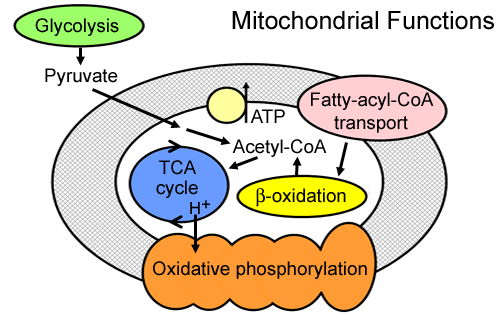
Below is a wonderfully simple depiction of the mitochondria that depicts one of the points I've been trying to raise above the current internet noise about mitochondrial dysfunction.  That being that when it comes to carb burning (glycolysis) the initial steps occur outside the mitos while fat burning (ß-oxidation) occurs within the mitos.  However both create Acetyl-CoA, and from that point on, metabolism and energy production is the same.  

Read more »

Wednesday, October 5, 2011

Fat Metabolism in Formerly Obese Women: Part II Resting Substrate Usage

Continuing the discussion from Part I

Fat metabolism in formerly obese women
Ranneries, et.al.  AJP-Endo, 1998.

In this part I wish to address the respiratory quotient, RQ.  The RQ is a measure of the relative amounts of energy derived from glucose oxidation vs. fatty acid oxidation.  

To recap the subjects of this study, when obese, the FO (formerly obese) subjects had body weights in excess of 120% normal weight.  They followed a conventional CRD to lose the weight and were weight stable for at least 2 months at 110% normal weight.  So weight losses were in excess of 10% bw and ranged from 15-20kg (33-44 lbs).    The FO & C groups were well matched as seen in Table 1.
Read more »

Saturday, October 1, 2011

Mitochondria and Insulin Resistance

I hadn't paid much attention to this whole mitochondria thing, mostly because it would require some sort of en masse genetic switcharooni for dysfunctional mitochondria to have spurned the epidemic in diobesetes* in this country (and around the world).  

I had just happened across the paper briefly discussed in my last post looking for something else.  It is interesting what a simple PubMed search on the apparent head of the research group:  Dr. John Holloszy turns up.  Lots and lots about mitochondrial biogenesis.  

One such paper is this fairly recent, 2008, review paper by Holloszy.  
Read more »

Friday, September 30, 2011

Mitochondria and High Fat Diets

Lots of buzz over mitochondria of late.  So I thought I'd share this find:

High-fat diets cause insulin resistance despite an increase in muscle mitochondria
It has been hypothesized that insulin resistance is mediated by a deficiency of mitochondria in skeletal muscle. In keeping with this hypothesis, high-fat diets that cause insulin resistance have been reported to result in a decrease in muscle mitochondria.    In contrast, we found that feeding rats high-fat diets that cause muscle insulin resistance results in a concomitant gradual increase in muscle mitochondria.
Read more »